
Abstract
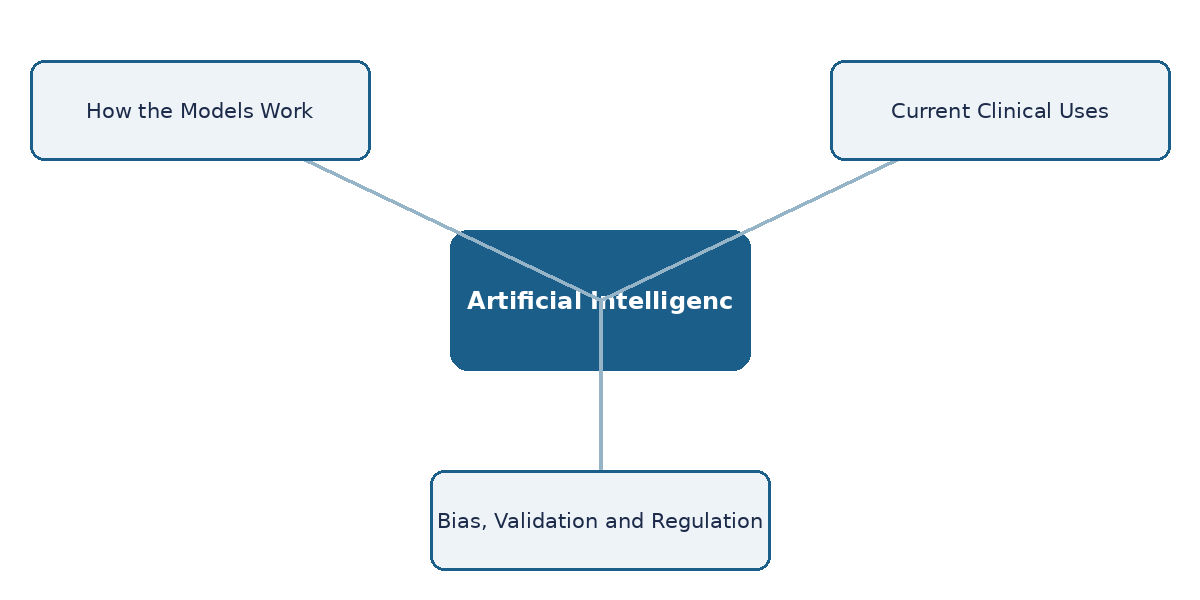
Artificial intelligence in surgical imaging has evolved rapidly over the past decade. This narrative review summarizes how the models work, current clinical uses, and bias, validation and regulation, and highlights practical points for clinicians. (Fictional content for template demonstration.)
Introduction
Interest in artificial intelligence in surgical imaging has grown substantially1,2,3. This review aims to provide a concise overview for clinicians and trainees.
How the Models Work
This section discusses how the models work in relation to artificial intelligence in surgical imaging3,4. Key considerations include patient selection, available resources and the quality of supporting evidence.
Current recommendations are largely based on observational data, and high-quality comparative studies remain scarce.
Current Clinical Uses
This section discusses current clinical uses in relation to artificial intelligence in surgical imaging5,6. Key considerations include patient selection, available resources and the quality of supporting evidence.
Current recommendations are largely based on observational data, and high-quality comparative studies remain scarce.
Bias, Validation and Regulation
This section discusses bias, validation and regulation in relation to artificial intelligence in surgical imaging7,8. Key considerations include patient selection, available resources and the quality of supporting evidence.
Current recommendations are largely based on observational data, and high-quality comparative studies remain scarce.
Conclusion
Artificial intelligence in surgical imaging offers meaningful benefits when applied thoughtfully. Ongoing research should focus on standardized outcomes and long-term follow-up10.
References
- Walker A, Haddad B, et al. Example reference 1 on artificial intelligence in surgical imaging. Sample J Med. 2017;2:80-316.
- Lin A, Huang B, et al. Example reference 2 on artificial intelligence in surgical imaging. Sample J Med. 2021;35:103-495.
- Chang A, Kuo B, et al. Example reference 3 on artificial intelligence in surgical imaging. Sample J Med. 2018;20:139-578.
- Tanaka A, Novak B, et al. Example reference 4 on artificial intelligence in surgical imaging. Sample J Med. 2024;8:109-574.
- Novak A, Walker B, et al. Example reference 5 on artificial intelligence in surgical imaging. Sample J Med. 2024;16:37-509.
- Kuo A, Lai B, et al. Example reference 6 on artificial intelligence in surgical imaging. Sample J Med. 2016;22:73-347.
- Cheng A, Cheng B, et al. Example reference 7 on artificial intelligence in surgical imaging. Sample J Med. 2017;28:188-391.
- Chen A, Liu B, et al. Example reference 8 on artificial intelligence in surgical imaging. Sample J Med. 2022;40:228-549.
- Tsai A, Lin B, et al. Example reference 9 on artificial intelligence in surgical imaging. Sample J Med. 2025;39:175-534.
- Yang A, Lai B, et al. Example reference 10 on artificial intelligence in surgical imaging. Sample J Med. 2016;15:4-485.
How to cite
Shu-Fen Chen, Mei-Ling Chen, Marcus Wu, Marcus Tanaka, Marcus Haddad, Ya-Wen Haddad. Artificial Intelligence in Surgical Imaging: Opportunities and Pitfalls. Lumina Journal of Clinical Medicine; 2026; 12(3):64-72. doi:10.5555/LJCM.202609_12(3).0003