
Abstract
Background: Postoperative delirium is common after hip arthroplasty in older adults, but simple preoperative predictors are lacking.
Methods: We prospectively enrolled 312 patients aged 70 years or older. Frailty was measured with a 30-item frailty index before surgery, and delirium was assessed twice daily for five days.
Results: Delirium occurred in 58 patients (18.6%). Each 0.1 increase in the frailty index was associated with higher odds of delirium (adjusted odds ratio 1.84; 95% confidence interval 1.41–2.40; p < 0.001).
Conclusion: A preoperative frailty index identifies older adults at high risk of delirium and may guide targeted prevention. (Fictional data for template demonstration.)
Introduction
Postoperative delirium affects up to one third of older adults after orthopedic surgery1–3 and is associated with longer hospital stay, functional decline and higher mortality.4
Frailty reflects reduced physiological reserve and may explain why some patients are more vulnerable than others.5,6 We examined whether a simple frailty index predicts delirium after hip arthroplasty.
Methods
This prospective cohort study was conducted at two fictional teaching hospitals between January 2024 and June 2025 (Fig. 1). Patients aged 70 years or older undergoing elective or urgent hip arthroplasty were eligible.
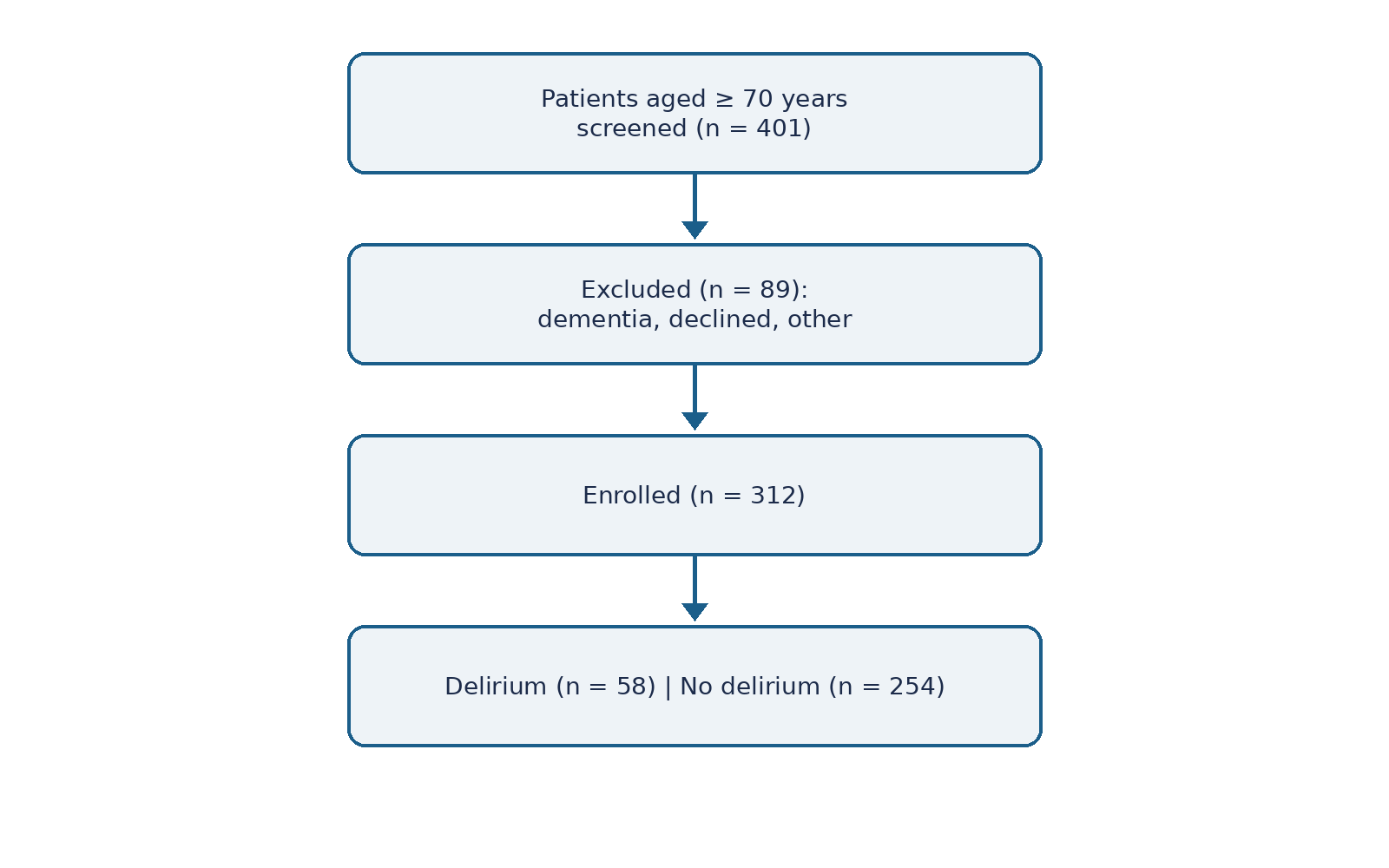
Delirium was assessed with the Confusion Assessment Method twice daily.7 Logistic regression was adjusted for age, sex, cognitive status and anesthesia type. A two-sided p-value below 0.05 was considered significant.
Results
Of 312 patients, 58 (18.6%) developed delirium. Baseline characteristics are shown in Table 1. Patients with delirium had a higher frailty index and more often received general anesthesia (Table 2).
Table 1. Baseline characteristics of patients with and without delirium
| Characteristic | Delirium (n = 58) | No delirium (n = 254) | p value |
|---|---|---|---|
| Age, years, mean (SD) | 81.2 (5.9) | 77.4 (5.1) | < 0.001a |
| Female sex, n (%) | 39 (67.2) | 161 (63.4) | 0.58b |
| Frailty index, mean (SD) | 0.31 (0.08) | 0.22 (0.07) | < 0.001a |
| ASA class III–IV, n (%) | 41 (70.7) | 121 (47.6) | 0.002b |
SD: standard deviation; ASA: American Society of Anesthesiologists.
Table 2. Anesthesia and surgical factors
| Factor | Delirium | p value | |
|---|---|---|---|
| Yes (n = 58) | No (n = 254) | ||
| General anesthesia, n (%) | 35 (60.3) | 98 (38.6) | 0.003 |
| Operative time, min, mean (SD) | 104 (31) | 92 (27) | 0.004 |
In the adjusted model, each 0.1 increase in frailty index was associated with an odds ratio of 1.84 for delirium.8
Discussion
Our findings agree with earlier work linking frailty and delirium.9,10 A guideline-based approach to perioperative assessment was recently summarized by an international working group.11 Limitations include the observational design and the use of a single frailty instrument.12
Conclusion
A preoperative frailty index is a practical tool to identify patients who may benefit from delirium prevention programs.
References
- Moreno A, Chen B, et al. Delirium after orthopedic surgery — study 1. Sample J Med. 2019;11:67-72. doi: 10.5555/sjm.2019.756
- Haddad A, Moreno B, et al. Incidence of postoperative delirium — study 2. Sample J Med. 2017;32:116-128. doi: 10.5555/sjm.2017.214
- Tanaka A, Walker B, et al. Delirium in hip fracture patients — study 3. Sample J Med. 2022;47:163-174. doi: 10.5555/sjm.2022.440
- Raman A, Wu B, et al. Outcomes of postoperative delirium — study 4. Sample J Med. 2019;18:38-50. doi: 10.5555/sjm.2019.949
- Haddad A, Huang B, et al. Frailty and surgical outcomes — study 5. Sample J Med. 2022;19:293-299. doi: 10.5555/sjm.2022.965
- Chen A, Lin B, et al. Frailty index construction — study 6. Sample J Med. 2019;31:80-85. doi: 10.5555/sjm.2019.120
- Haddad A, Tanaka B, et al. Confusion Assessment Method validation — study 7. Sample J Med. 2021;35:273-284. doi: 10.5555/sjm.2021.484
- Fischer A, Tsai B, et al. Multivariable models in perioperative research — study 8. Sample J Med. 2018;56:327-339. doi: 10.5555/sjm.2018.880
- Tsai A, Huang B, et al. Frailty and delirium meta-analysis — study 9. Sample J Med. 2020;32:258-268. doi: 10.5555/sjm.2020.932
- Lin A, Walker B, et al. Prehabilitation in frail older adults — study 10. Sample J Med. 2021;42:327-336. doi: 10.5555/sjm.2021.834
- World Example Health Organization. Perioperative care of older adults: a practical guide. Available at https://www.example.org/guides/perioperative-older-adults. Accessed March 3, 2026.
- Novak L, Raman P. Limitations of single frailty instruments. Example Surg Rev. 2024;11:201-209. doi: 10.5555/esr.2024.0211
How to cite
Chih-Hao Lin, Sophia Moreno, Po-Han Wu, Shu-Fen Tsai. Association Between Frailty Index and Postoperative Delirium in Older Adults Undergoing Hip Arthroplasty: A Prospective Cohort Study. Lumina Journal of Clinical Medicine; 2026; 12(4):80-87. doi:10.5555/LJCM.202612_12(4).0002