
Abstract
Background: The optimal approach to surgical site infection after abdominal wall reconstruction remains debated, and evidence from routine clinical practice is limited.
Objective: To compare surgical site infection within 30 days between the infection group and the no infection group.
Methods: This study included 245 adults undergoing elective abdominal wall reconstruction with mesh treated at two fictional teaching hospitals. The primary outcome was surgical site infection within 30 days. Groups were compared using appropriate parametric and non-parametric tests.
Results: Body mass index (kg/m²) was 33.8 ± 5.2 in the infection group and 29.1 ± 4.7 in the no infection group (p <0.001). Active smoking, n (%) also differed between groups (11 (35.5) vs. 34 (15.9)).
Conclusion: In this sample, infection was associated with favourable results. Prospective studies are needed to confirm these findings. (All data in this article are fictional and for template demonstration only.)
Introduction
Surgical site infection after abdominal wall reconstruction is a common clinical question in daily practice1,2. Variation between centres is considerable, and published series often include small numbers of patients3.
Previous reports suggest that outcomes may depend on patient selection, perioperative care and follow-up protocols4,5. The aim of this study was to compare surgical site infection within 30 days between the infection group and the no infection group.
Materials and Methods
Study design and patients
We reviewed 245 adults undergoing elective abdominal wall reconstruction with mesh between January 2022 and December 2024. Patients were divided into two groups: infection (n = 31) and no infection (n = 214). The study was approved by the institutional review board (fictional approval no. EX-2025-001).
Outcomes and statistical analysis
The primary outcome was surgical site infection within 30 days. Secondary outcomes are listed in Table 1. Continuous variables are presented as mean ± standard deviation and compared with Student's t-test; categorical variables were compared with the chi-square or Fisher's exact test. A p value below 0.05 was considered significant.
Results
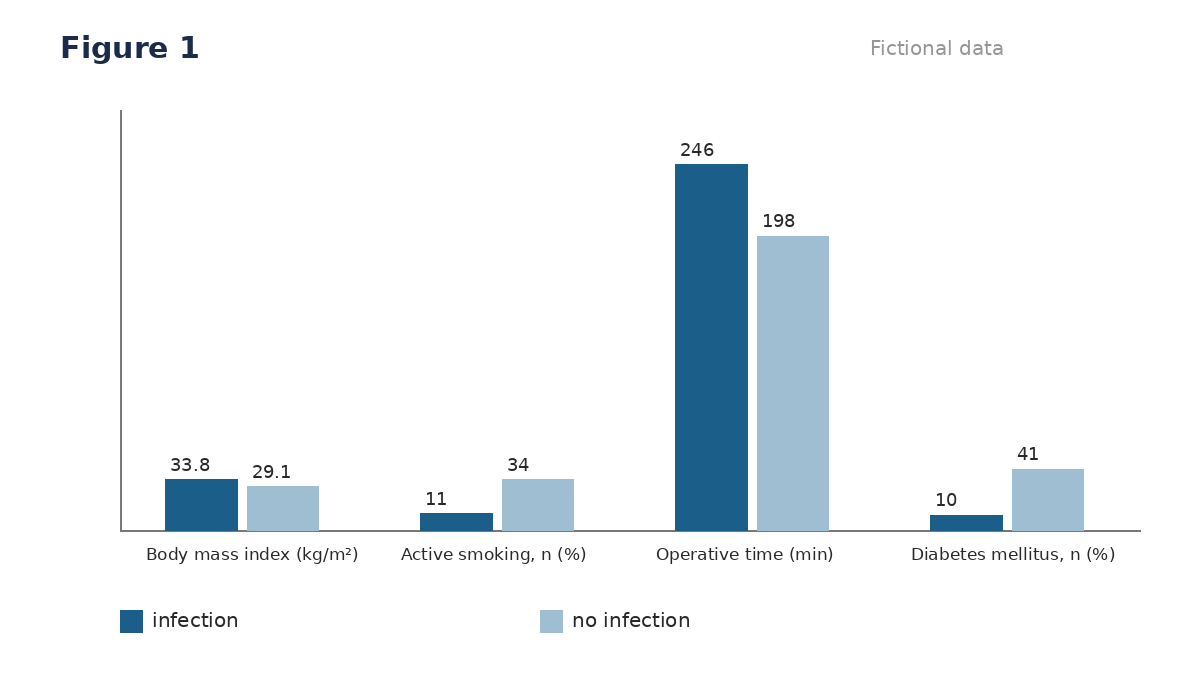
Baseline characteristics were comparable between groups. Body mass index (kg/m²) was 33.8 ± 5.2 in the infection group and 29.1 ± 4.7 in the no infection group (p <0.001; Table 1, Figure 1).
Table 1. Outcomes by group
| Outcome | Infection | No infection | p value |
|---|---|---|---|
| Body mass index (kg/m²) | 33.8 ± 5.2 | 29.1 ± 4.7 | <0.001 |
| Active smoking, n (%) | 11 (35.5) | 34 (15.9) | 0.008 |
| Operative time (min) | 246 ± 61 | 198 ± 55 | <0.001 |
| Diabetes mellitus, n (%) | 10 (32.3) | 41 (19.2) | 0.09 |
Discussion
In this cohort, the infection group showed better results for several outcomes. These findings are in line with earlier reports5,6, although differences in definitions make direct comparison difficult7.
This study has limitations. It was retrospective, performed at two centres, and unmeasured confounders may have influenced the results. Larger prospective studies are warranted.
Conclusion
Infection was associated with improved surgical site infection within 30 days in this fictional sample. The approach appears safe and may be considered in routine practice8.
References
- Tsai A, Kuo B, et al. Example reference 1 on surgical site infection after abdominal wall reconstruction. Sample J Med. 2019;5:86-382.
- Hsu A, Sato B, et al. Example reference 2 on surgical site infection after abdominal wall reconstruction. Sample J Med. 2017;18:151-533.
- Lai A, Tanaka B, et al. Example reference 3 on surgical site infection after abdominal wall reconstruction. Sample J Med. 2022;8:13-460.
- Walker A, Lai B, et al. Example reference 4 on surgical site infection after abdominal wall reconstruction. Sample J Med. 2021;13:133-356.
- Hsu A, Sato B, et al. Example reference 5 on surgical site infection after abdominal wall reconstruction. Sample J Med. 2018;39:222-311.
- Yang A, Chen B, et al. Example reference 6 on surgical site infection after abdominal wall reconstruction. Sample J Med. 2021;10:19-383.
- Fischer A, Sato B, et al. Example reference 7 on surgical site infection after abdominal wall reconstruction. Sample J Med. 2025;28:279-413.
- Sato A, Fischer B, et al. Example reference 8 on surgical site infection after abdominal wall reconstruction. Sample J Med. 2018;34:16-503.
How to cite
Po-Han Raman, Priya Tsai, Shu-Fen Lin, Mei-Ling Fischer, Kuan-Ting Hsu. Predictors of Surgical Site Infection Following Elective Abdominal Wall Reconstruction. Lumina Journal of Clinical Medicine; 2025; 11(4):189-196. doi:10.5555/LJCM.202512_11(4).0002